
Get in touch with us
We at accompio will be happy to help you.


16.10.2026
Servers and networks are up and running; the monitoring dashboards show no abnormalities – and yet users complain about slow or inaccessible applications. How do these two things fit together? Often, the answer lies in the fact that the technical infrastructure is functioning, but the actual usage of an application is not sufficiently monitored.

Christian Doll works in the field of Application Performance Monitoring (APM) and helps companies make performance and availability measurable from the perspective of users. In an interview, he explains what monitoring levels there are, how user experience can be objectively evaluated, and why companies are best off starting with their most important business processes.
Explains in the full expert interview Christian Doll, expert in application performance monitoring at accompio, How companies can measure the actual user experience and use end-user observability in a meaningful way.
Classic infrastructure monitoring provides important information about servers, storage, and network components. However, even if these systems are technically available, users may fail to access an application.
As an example: After an update, a JavaScript in the browser no longer works correctly. This may even prevent any request from being sent to the server at all. Altered permissions or an inaccessible third-party interface can also prevent users from completing their tasks.
Such errors are not necessarily visible in the classic infrastructure dashboards. However, this does not make a difference for the affected users: The service does not work as expected for them.
Companies therefore need to ask an additional question: Can users actually complete their tasks successfully?
Monitoring can be divided into different levels, each of which provides different information:
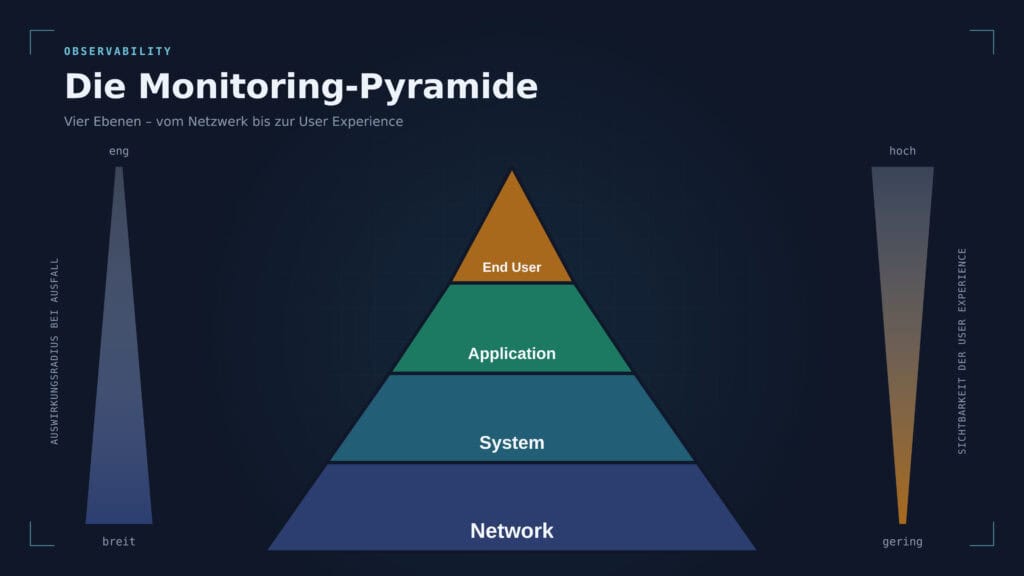
The levels complement each other. While Infrastructure and application monitoring While End-User Observability provides technical insights into potential problems, it also considers the entire usage process. This also allows for the detection of errors that only occur when various components interact.
This is particularly relevant in business-critical processes: If an order, quote or report cannot be created, this has an immediate impact on the work in the company.
Different methods are available for monitoring from the user perspective. Two important approaches are synthetic monitoring and real-user monitoring.
Synthetic monitoring Simulates defined usage processes at regular intervals. For example, it is checked whether a user can successfully complete a specific business process. This enables continuous measurements – even when no one is actively using the application at the moment.
Real user monitoring On the other hand, it evaluates actual requests and interactions. This allows real errors and response times to be captured and categorized. For this, additional technical resources and a higher administrative effort are required depending on the implementation. Data privacy aspects must also be taken into account, for example by masking sensitive information.
Which method is suitable depends on the specific service and requirements. Both approaches can complement each other: Synthetic tests continuously monitor defined processes, while real-user monitoring provides insights into actual usage.
When users report that an application responds more slowly at certain times of the day, this is initially a subjective perception. Without measurement data, it is difficult to determine what happened at that time in retrospect.
End-user observability creates an objective basis. Relevant metrics include in particular:
Based on this information, companies can identify how applications perform in everyday use and where there is room for improvement. The data helps them prioritize technical measures specifically, such as allocating additional resources or investigating bottlenecks.
Service Level Agreements (SLAs) and Service Level Objectives (SLOs) can also be reviewed using this method. For example, companies can define how available a service must be or what maximum response time for an action is acceptable. Measurement data then shows whether these requirements are met.
A single user action can involve numerous components and dependencies – from the client application to the network and to databases or external services. Particularly with third-party interfaces, companies often lack direct insight into the underlying infrastructure.
End-to-end monitoring helps to examine such processes from the user’s perspective and make problems visible throughout the usage process. Solutions such as OpenText Application Performance Management and Business Process Monitoring offer, among other things, synthetic monitoring, real-user monitoring, and capabilities for analyzing and sharing measurement data.
For the future, Christian Doll sees particular potential in AI-based analysis. In many companies, there are several monitoring tools that each capture different events. When this information is combined, it is easier to identify possible connections – for example, between a network outage, a database problem, and the failure of an application.
Information from change management can also help to narrow down the causes. This may make it easier to determine more quickly whether a recent change is related to a disruption.

accompio helps companies make sense of monitoring solutions, make dependencies visible, and assess the quality of business-critical IT services from the perspective of the users.
End-User Observability extends classic monitoring with a crucial perspective: It’s not just the technical infrastructure that matters, but also the question of whether users can actually carry out their work.
Companies do not need to immediately monitor all applications for this purpose. Christian Doll recommends starting with a key service and a critical business process. Together with the relevant administrators and service managers, the relevant components, dependencies, and measurement points should be identified.
This creates progressively actionable data that can be used to understand complaints, prioritize improvements, and evaluate the quality of service.
„Start slowly. Find a service.“
Christian Doll, expert in application performance monitoring at accompio

With his extensive experience, Christian helps companies measure performance and availability from the perspective of users.
End-User Observability examines whether applications are available and performant from the user’s perspective. It complements classic monitoring by providing information on whether important usage processes are actually working.
Application Monitoring looks at technical information about an application, such as logs and running processes. End-user observability additionally examines the actual usability and performance from a user perspective.
Synthetic monitoring simulates defined usage processes on a regular basis and can therefore also measure them without active users. Real-user monitoring, on the other hand, evaluates actual requests and interactions.
It makes availability, response times, and errors measurable from the user perspective. Companies can objectively evaluate complaints, identify problems earlier, and prioritize optimizations more purposefully.
It makes sense to start with a business-critical service and an important business process. Together with the relevant teams, relevant components, dependencies, and measurement points are defined, and the results are then evaluated.
