
Get in touch with us
We at accompio will be happy to help you.


05.03.2024
In the final part of his blog series, Tom examines the risks of using AI systems and outlines ways to minimise these risks.

In today's connected world, AI translators such as DeepL and Google Translate are indispensable. In the previous chapter, I put these translators through their paces. But as with all technologies, the use of AI translators also carries certain risks. In this chapter, I will conclude my blog series and take a closer look at these risk factors and how they can be minimised.
Language is constantly changing. Not only the style but also the rules of the German language have changed considerably in recent years. New words and phrases have been introduced (Youth Word of the Year 2023: „Goofy“), while others have become outdated and less common. The influences of technology, social media, and cultural exchange have led to a rapid evolution of language In addition, grammar and spelling have also evolved to reflect changes in society and communication.
so that these trends and developments can also be reflected in the translations, the AI translator always kept up to date werden, especially the training data. The system learns from the training data to handle unknown texts and interpret them in a way that takes into account both the context and the nuances of the original text. If this data is not up-to-date, the system could Providing translations that are no longer current.
So-called feedback loops allow systems to learn from mistakes and improve their own performance over time. For instance, if an AI translator mistranslates a piece of text, a user of the system can flag that translation as „bad“ and suggest an alternative „correct“ translation. This can then allow the system to use the suggested „correct“ translation to adapt and improve its internal models. This process of continuous improvement allows the AI translator to autonomously refine its capabilities over time and become more accurate. However, it's important to note that the quality of the feedback – that is, whether a translation is marked as good or bad – and the accuracy of the suggested „correct“ translation have a significant impact on this process. Incorrect or misleading feedback, whether intentional or unintentional, could lead the system to Incorrect translations interpreted as correct, these errors are repeated in future translations or even offensive content is embedded in the system.
So that this doesn't happen, this feedback should be carefully reviewed and moderated. This could be a combination of automated systems and human reviewers. In this way, the risk can be minimised that incorrect or misleading feedback will affect the performance or accuracy of the AI translator.
In every AI system, so-called „overfitting“ can occur. Overfitting occurs when a model is so adapted to the training data that it loses flexibility and performs poorly on new, unknown data. As a result, the AI system does not learn to recognise the underlying patterns. This leads to inaccurate predictions and poor overall performance of the model.
To ensure this behaviour is detected in a system test, a separate, independent test dataset should be used that has not been used for training – or, more accurately, cannot be used. In previous chapter I have already drawn attention to this issue.
As previously mentioned, training data is required for an AI system to function at all. However, one should ensure that this data No personal or private information include, such as names, addresses, phone numbers or other identifying features. If this data is still used for the training of an AI system, there is a risk that the privacy of the individuals concerned will be violated. This is because an attacker could potentially gain access to this data and they misuse for undesirable purposes.
To prevent targeted advertising, identity theft, or even blackmail through the use of an AI system, all those connected to the AI Data anonymised including, in particular, training data. Data cleansing should also be part of the feedback loop. Otherwise, there is also the risk that entered information will be used unfiltered.
The aspects mentioned so far represent only a small selection of the risks. Further risks include:
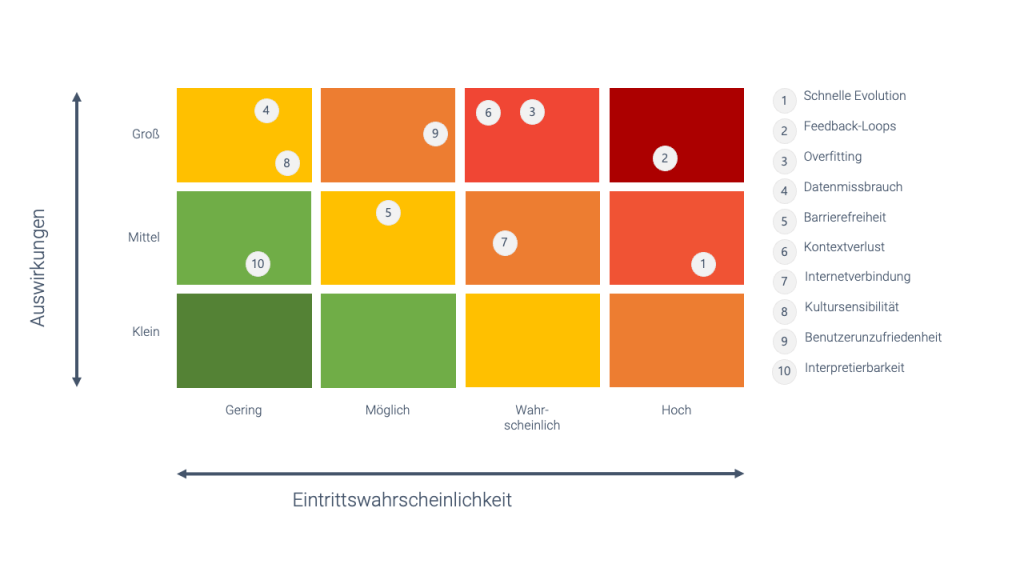
At the end of my review, I've compared and weighed all aspects regarding their impact and likelihood of occurrence. This allows for targeted prioritisation of the risks. It is important that this representation is very simplified and only reflects my personal perception based on the experiences I had during my AI Testing Trip„ done.
Given the risks described, it is important that the development and deployment of AI systems are carried out responsibly and with the utmost care. This applies to AI translators, as well as to other systems that use artificial intelligence. However, many other risks need to be considered for other systems. Further information on this can be found at ISTQB Certification for Testing Artificial Intelligence. By considering these risk factors, developers can unleashing the full potential of AI translators and simultaneously protect the privacy and quality of translations.
This chapter marks the end of my journey through the world of AI testing. Looking back, my first experiments with the „Teachable Machine“ from the first chapter very helpful in better understanding how machine learning works. The Analysis of AI-specific quality characteristics and the subsequent Integrating test cases into ALM Octane In the following chapters, together with the risk analysis, they form a fitting conclusion. I remain excited about the interesting AI topics the future holds.
